Astronomers are uncovering fascinating new evidence that suggests our galaxy, the Milky Way, might be located within a massive cosmic void.
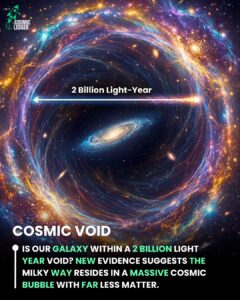

This void is estimated to span nearly 2 billion light-years across, making it an enormous region of space that contains far fewer galaxies and stars than typical regions of the universe. This discovery could dramatically alter our understanding of the cosmos and our place in it.
The universe is not evenly distributed with matter. Instead, it consists of vast structures like galaxy clusters, separated by massive voids. These voids, which are essentially empty regions, stretch across vast distances, and recent research suggests that the Milky Way could be nestled within one of these underdense regions. Such a void would explain a lot about the strange dynamics observed in our part of the universe, including the Hubble tension, which is the discrepancy between the expansion rates of the early universe and the current rate we observe in nearby galaxies.