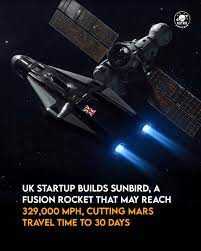
Space travel is about to enter a whole new era. A UK startup has unveiled Sunbird, a revolutionary fusion-powered rocket capable of reaching an astonishing 329,000 miles per hour. This breakthrough technology could slash travel time to Mars from months to just 30 days, transforming humanity’s approach to interplanetary exploration.
Sunbird represents a major leap forward in propulsion technology. Fusion power, long considered the holy grail of energy, provides immense thrust without the limitations of traditional chemical rockets. By harnessing this energy, the rocket can maintain high speeds over vast distances, dramatically reducing travel times while carrying cargo and crew safely through deep space.
The implications for Mars missions are staggering. Current spacecraft take six to nine months to reach the Red Planet, requiring massive resources and life-support systems for extended journeys. With Sunbird, astronauts could complete the journey in a fraction of the time, reducing risks associated with long-duration spaceflight, such as radiation exposure, muscle loss, and psychological strain. Faster travel also opens the door for more frequent supply missions and emergency support for future Martian colonies.